
Submit
What and How to Submit
Send no more than 3 poems in an attachment to OddPocketPress@gmail.com
In the body of the email, include a brief note with your name, contact information, a brief bio and list of the titles of the poems you are submitting. We read blindly so make sure that none of your personal information appears on the attached submission itself.
Use the subject line “Odd Pocket Submission from Your Name”
If any of our guest editors recognize your work, they will recuse themselves from judging your work and will leave decisions up to the other editors.
If the judge recognizes a poem, the poem will not be eligible for consideration and the submission fee will be returned.
We will try to respond to your submission within 2 - 3 months. Please don’t query any earlier than that.
All submissions are considered for our quarterly contest. (Read more about it here.)
Simultaneous submissions are allowed, but if you withdraw your poem it won’t be eligible for publication in our journal or consideration in our contest, so why do that? Send us your best work and then go write new work for the other journals.
The submission fee is $15. Fees help us keep going, reading, publishing, offering prizes and building a community around the arts.
Donate another $15 and provide a submission fee for another poet, plus get kind and supportive feedback on your work from us.
Not sure what to submit? Meet our editors (below) and see what they’re looking for in the poems they want to read.
Meet Our Guest-Editors for Issue # 1
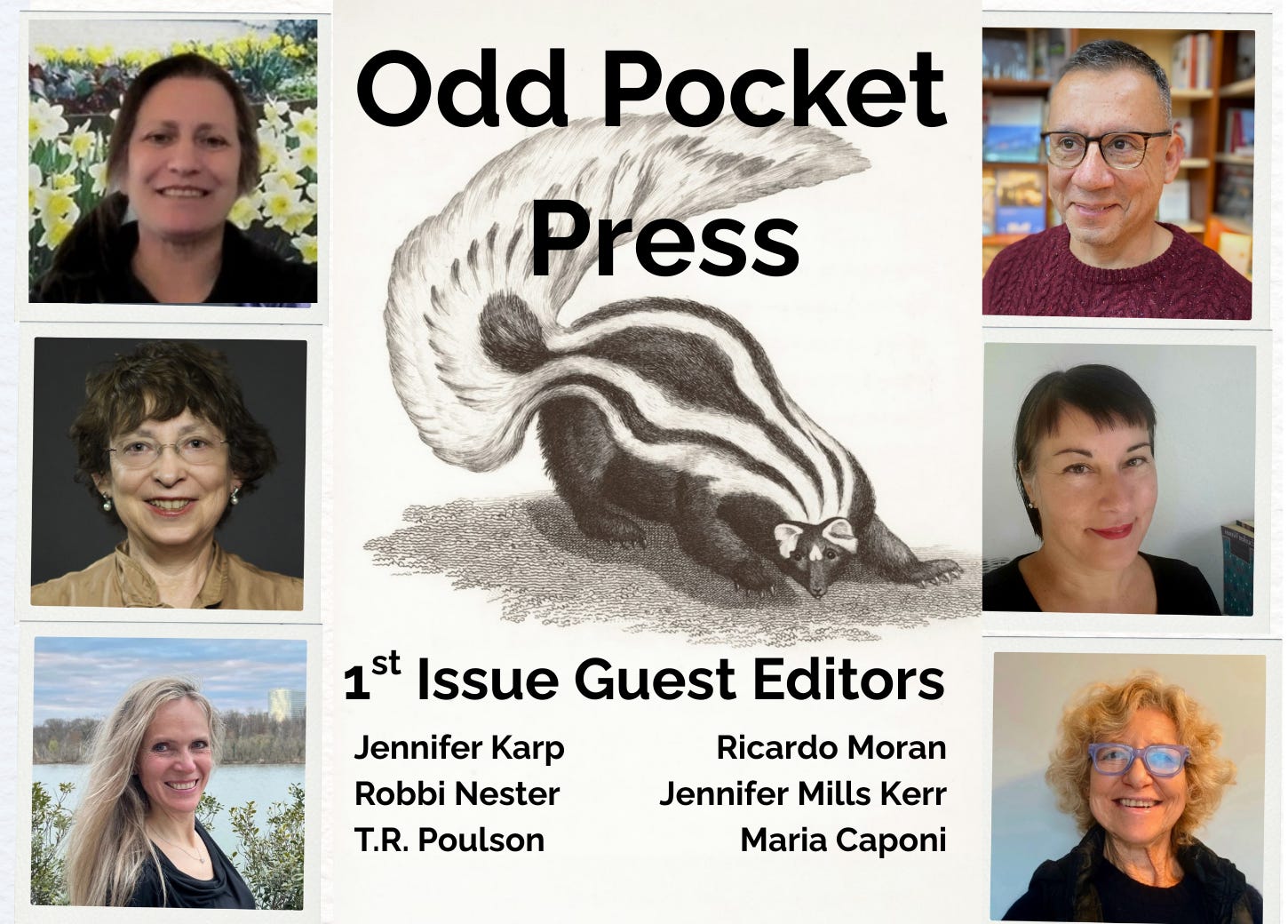
Jennifer Mills Kerr
Jennifer lives in Northern California. Her poetry has been recently published in January House, Moss Trill, & Neologism. She leads art-inspired writing workshops online and curates poems on the Poetry-Inspired Substack (@JenniferMillsKerr). Lit-amorous, she is constantly seeking the next amazing poem to read, savor, and share. Learn more about Jennifer at her website, www.JenniferMillsKerrPoet.com.
“I love poems with strong imagery, accessible topics, surprising words. I’m good with poems that use space in an interesting way, too.
Poems that turn me off are those that use amazing language but are hard for me to connect with. I like poems that have some heart, rather than those that are mainly cerebral. I dislike repeated rhyme. I can also become frustrated if a poem has zero shift, turn, or change within its territory.”
Ricardo Moran
Ricardo is a past recipient of the Peter K. Hixson Memorial Award for Poetry. His writing has been published in Beatific Magazine, Cider Press Review, East Jasmine Review, The Seattle Star, and Willa Cather Review. He is a former board member and currently serves on the advisory board for San Diego Writers, Ink. and is a former associate editor with Zoetic Press. His debut poetry anthology, Not Quite Heaven, from Broken Tribe Press, was published in 2025 and was shortlisted for the 2024 Tribe Poetry Award. He lives in Albania, enjoys traveling, and learning how to say “good morning” in as many languages as possible. In every timeline, you can find him reading, writing, and plotting right here: www.ricardomoranwriter.com
“When I read a poem, I look for a strong structure and interesting use of language. First, I read each poem with the hope that it will resonate on an emotional level. In order for that to happen, I focus on how the poet uses language: how the poet paints a picture and do they have a message to share? Assonance and consonance are important to me as are the line breaks if the poet is using enjambment to increase the tension or adjust the pace. I enjoy poems that are focused on the aesthetic and can pull the reader into a space that describes a moment in time. I believe that in rewriting and editing you discover new ways to deliver the poem’s message either by playing with the structure of the poem or with the phonetics of language.
What turns me off about a poem is when it is written as a series of generalities instead of specifics. This gives me the impression that the poet is avoiding the pain or discomfort that they want to express, but are afraid to put it on paper. I think sometimes poets will self censor, and will end up writing a poem that lacks direction and dances around a difficult topic.”
Maria Caponi
Maria was born and raised in Buenos Aires, Argentina. An only child with a vivid imagination, she spent much of her childhood inventing stories and working on mathematical equations. She has a Ph.D. in Physics and Astronomy from the University of Maryland and a Certificate of Creative Fiction Writing with honors from the University of California, Los Angeles. Maria has lived in Los Angeles since her late twenties. Her memoir, An Accidental Pilgrim, a memoir in prose and verse was published in 2024. She’s currently completing a collection of personal essays and poems. You can find more details about her work and interests at https://mariacaponi.com/
“I look for music, rhythm, and emotion. I like to see a story, even if it is ambiguous, something that is at stake that makes me want to read to the end. I also like something creative, magical that makes me curious, or makes me want to read the poem again.
I’m turned off by cliches and unnecessary repetition, or a poem that is too vague.”
T. R. Poulson
T.R. Poulson is a University of Nevada alum and proud Wolf Pack fan, supports her writing habit by delivering for UPS in Woodside, California. Her work has appeared in various publications, including Best New Poets, Quarterly West, American Literary Review, Gulf Coast, and Booth. She is currently seeking a publisher for her first manuscript, tentatively titled At Starvation Falls. Find her at www.trpoulson.com and on social media as @trpoulson.
“What I look for in a poem are layers. I fall in love with poems that make me want to read them a second and third and fourth time. Poems that grow on me with each reading. I love formal poetry, and that is one way to form layers, but there are other ways that can be just as effective: story, metaphor, surprise, musicality, humor and irony among many other things.”
Robbi Nester
Robbi Nester is a poet, writer, and retired educator. She is the author of five books of poetry—a chapbook, Balance (White Violet, 2012), and four collections—A Likely Story (Moon Tide, 2014), Other-Wise (Kelsay, 2017), Narrow Bridge (Main Street Rag, 2019), and About to Disappear. She has also edited three anthologies of poetry, including The Liberal Media Made Me Do It! (Nine Toes, 2014), Birds, Beasts, and Trees (published as a special issue of Poemeleon poetry journal) and most recently, The Plague Papers. She hosts two monthly poetry reading series.
Robbi holds an MA in Writing from Hollins University, an MFA in Poetry from UC Irvine, and a PhD in Comparative Literature from UC Irvine. She taught composition and literature at all levels for over 30 years at various colleges and universities, as well as Humanities Core Course and a survey in the novel, Romance and Realism at the University of California, Irvine. Although she has retired from teaching in the classroom, Robbi still tutors and freelances as a writer and editor, working with students from 15 through graduate school and adult writers of all ages.
“To pass muster for me, poems must show a keen awareness of sonics, poetic conventions, and offer a clear distinguishing originality of mind and evidence of an observant eye with such things as an engaging voice/persona and imagery.”
Jennifer Karp
Jennifer is a disabled writer, holding a degree in literature from The American University in Washington, DC, where she took graduate level poetry classes with Pulitzer winning poet Henry Taylor. A forever student, she continues to study poetry with poet laureate Ron Salisbury, Kim Addonizio, Dorianne Laux, and many others. Her recents: she was short-listed in the 2025 Bridport Poetry contest, won first place, runner-up, and honorable mention in the 2025 International Memoir Association’s inaugural poetry contest, won honorable mention in the 2023 and 2025 Kowit poetry contest, and was a winner of the 2022 San Diego Reader poetry contest. Her work had been published abroad and domestically. She lives in San Diego.
Find her on social media: https://www.instagram.com/jennyfitgirl
“I look for music, rhythm, and tension in a poem. I like poems with contrasts: emotional, physical. I prefer poems written in easy to understand language that do not distract from the poem’s idea. Idea poems resonate well with me; poems that use the platform to connect us to human experience. I do not mind rhyming poems if the rhyme serves the poem effectively.
I dislike ornate poems that say very little with a lot of fancy words for the sake of sounding very literary, but do like poems with magical realism.”
Tresha Faye Haefner: Managing Editor and Grand High Pumba of The Poetry Salon
Tresha Faye Haefner’s poetry appears, or is forthcoming in several journals and magazines, most notably Blood Lotus, Blue Mesa Review, The Cincinnati Review, Five South, Hunger Mountain, Mid-America Review, Pirene’s Fountain, Poet Lore, Prairie Schooner, Radar, Rattle, TinderBox and Up the Staircase Quarterly. Her work has garnered several accolades, including the 2011 Robert and Adele Schiff Poetry Prize, and a 2012, 2020, and 2021 nomination for a Pushcart. Her first manuscript, “Pleasures of the Bear” was a finalist for prizes from both Moon City Press and Glass Lyre Press. It was published by Pine Row Press under the title When the Moon Had Antlers in 2023.
“I look for a poem that grabs my attention in the first line. It needs to have a sense of urgency, whether it be about a life-or-death situation, or an excitement over seeing a butterfly for the first time. That’s the most paramount thing for me. The second most important thing is specific and surprising imagery. I’m so delighted when someone shows me something I’ve never seen before, or makes me see an old thing in a new way. That being said, I’m amazed by how many poems I love that keep things simple. Sometimes simple language can convey profound emotions and ideas.”